Monika (86) arrived in Eisenhüttenstadt in 1968. She qualified as an IT specialist at the EKO. She feels grateful for the opportunities available to her at the time, but has mixed feelings about the upheavals of 1989/90.
“I was born in 1939, started school in 1945, and finished eighth grade in ’53. At that time, school didn’t go up to the tenth grade. So, I had to learn a trade. I did a three-year apprenticeship at the Sparkasse (savings bank). And because commercial clerks were so frowned upon under communism, my vocational certificate doesn’t say ‘Bank Clerk’, but rather ‘Money and Credit Administrator’. I worked at the Sparkasse for another five years, but you didn’t earn much as a commercial employee. Those who were in my class and trained as turners and millers earned much more. So, I went to Wismut, the uranium mining operation. I was born in Aue, and there was a large mechanical engineering plant there that was used for Wismut. That’s where it started with a bit of – not electronic, but mechanical – data processing. I was already doing that.
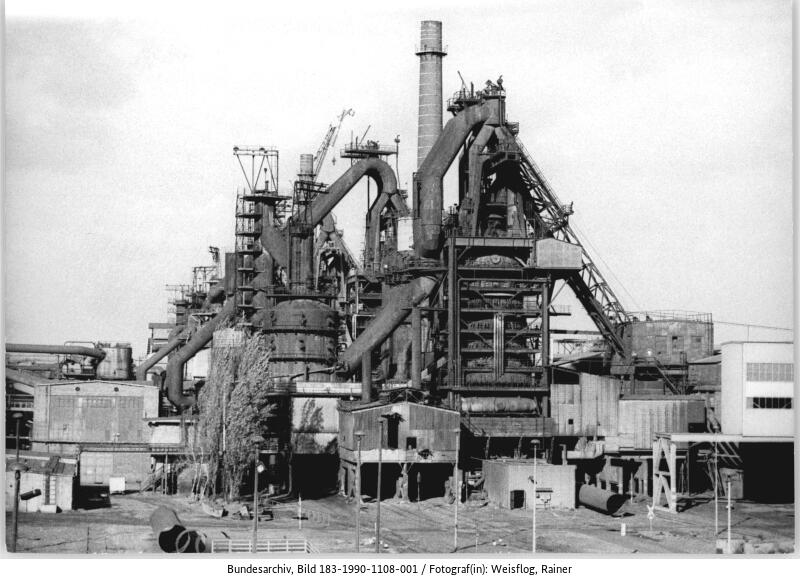
But after five years of marriage to my first husband, we still had no chance of getting an apartment there. And at that time, there was a lot of advertising for Eisenhüttenstadt. In 1968, there was an advertisement in the Wochenpost (weekly newspaper): ‘The new cold-rolling mill has been commissioned. People are wanted’. So we applied, and offers were made immediately. I was offered a position as Group Leader in the accounting department – but the condition was that I had to make up for my vocational school degree. So first, I attended the Volkshochschule (adult education center) for a year to get my tenth-grade equivalent. And then the time came when people started dealing with electronic data processing. At the EKO steelworks, they said: ‘We need to qualify IT people.‘ At that time, so-called ‘women’s special classes’ were established at the EKO. Women with children had good conditions there. Two days a week we had lectures and study, and three days we worked. I am glad that the EKO gave me this opportunity to do such a course of study. I am truly grateful for that. Because when I was still in Aue at Wismut, there was similar support, but only for women who were in the Party. And I was not in the (communist) party.
I remained a Group Leader in the accounting department for a while, but at the end of the 1970s, microcomputer projects started at the EKO. And that actually paved my way into data processing. I then got properly into IT programming and project planning – even after the Wende. The microcomputer project I was responsible for was eventually outsourced. And they offered me the chance to be taken over by the new company. It paid off very well financially. They weren’t stingy. But I also had to go on business trips to smaller branches repeatedly. I set up computer technology and trained people from Hambach in France to Katowice in Poland. That was very interesting and exciting. Working ten hours a day, then studying for another two hours at home, and then the housework. And now I am the ‘computer granny’.
At the time of the Wende, there was a spirit of new beginnings here. Although, of course, there was uncertainty too: What is going to happen to us now? But everyone thought that things were moving forward again and that development would continue toward the better. Because toward the end of the GDR, you could feel the decline. Supplies got worse, and you could see in the factories what was all being sold off. Black-market trading happened in every area. Everything ran through connections. In my hometown, many businesses were sold off cheaply after the Wende. That was actually quite criminal. Many ‘robbers’ came over, pretending to be this or that. In the West, they would have been in prison; here, they acted like big shots. And that is actually the terrible part – that it was only about the money, and that people were essentially left in the lurch. It’s no wonder that the AfD is so successful because of this. And that scares me quite a bit. Back then, the people employed in the factories should have been given more of an opportunity to start a company and develop their own business.”