After losing her job following German reunification, Christine (75) refused to give up. Reflecting on a life defined by change, she talks about solidarity and disappointment, and explains why she still believes in a brighter future for Weißwasser.
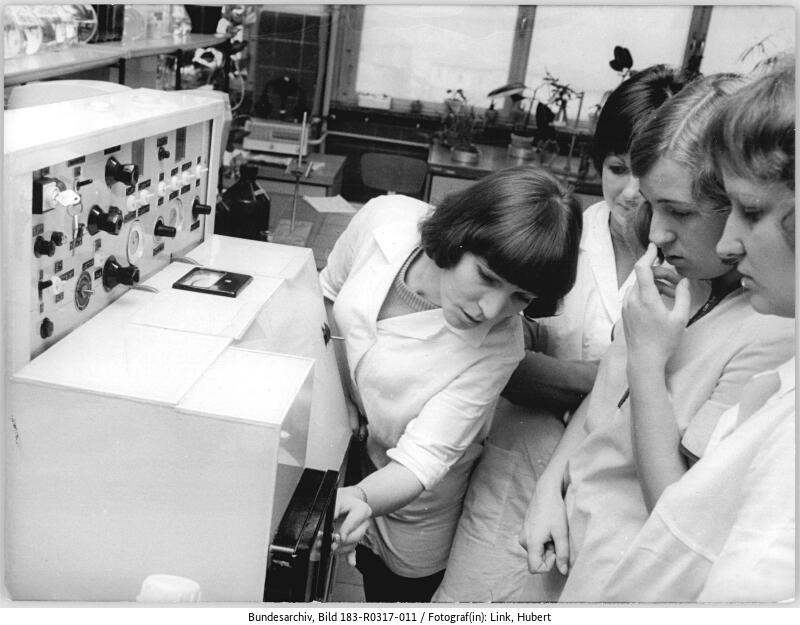
“I was born in the Bautzen district in 1951. After attending general polytechnic secondary school for ten years, I trained as a chemical laboratory assistant while earning my Abitur (university entrance qualification). I then moved to Berlin to study laboratory technology for three years. After that, I applied for a position in the same field at the Boxberg power plant. My application was successful and I was employed as a shift supervisor in chemical water treatment.
After the birth of our first son, I slowly stopped doing shift work. At that time, weekly nurseries and kindergartens still existed. However, in 1978, it was essentially decreed that children should be at home for a day at the weekend. Consequently, I could no longer fulfil my duties. As a shift supervisor, covering different shifts became very difficult.
During my time as a shift supervisor, I developed an in-depth understanding of technological processes. I then moved into maintenance, where I was responsible for the technological preparation of weekend repairs on the 210 MW and 500 MW plants. I received several commendations and awards for this work.
I became unemployed in 1998. The power plant was requiring fewer and fewer workers. I was at a disadvantage at the time because I was a woman working in the repair department. And the ‘new bosses’ from the old federal states were of the opinion that women had no business being in repair at all. And so, after various ‘busy-work’ tasks were completed, I was allowed to leave.
I then underwent retraining, qualifying as a real estate and housing manager with a certification from the IHK (Chamber of Industry and Commerce). I graduated with good results. However, none of that helped me because, by then, I was considered too old. At 50, you were dismissed as ‘too old’. I sought other training opportunities and completed them to a high standard. But it simply didn’t help.
I miss the sense of neighbourliness today. In the GDR, people helped each other out. It wasn’t even a question. But that’s not the case anymore. That vanished abruptly on the day of reunification. And that is sad. It’s truly sad.
We were happy. And then came the Wende. The Treuhand Agency primarily destroyed companies that could have acted as competitors. In our case, in Weißwasser, this was the glass industry. We had a thriving glass industry. However, it would have competed with companies in the ‘old’ federal states. That is why these specific companies were destroyed.
Many people are content to be carried by others, yet they aren’t willing to take action themselves. The one thing they are good at is complaining that nothing is happening. But when something is actually happening, nobody goes. Things can still get better though; we haven’t given up hope. My husband and I are always actively involved whenever something needs to be moved forward. We persevere.”