Andreas (85) returned to the GDR from West Germany as a young man. As a bricklayer, he was involved in the construction of Eisenhüttenstadt. After the Wende, he started his own business.
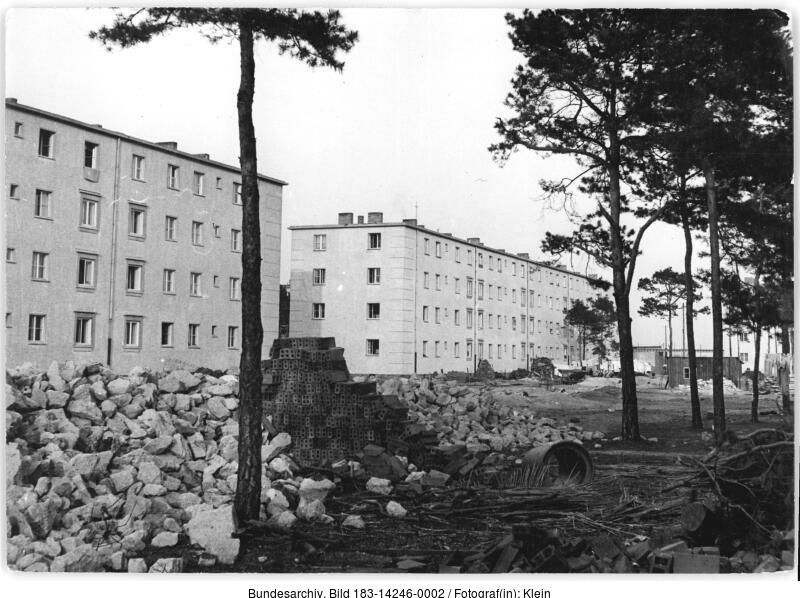
“I grew up with my aunt and my grandmother because I had no one else. My mother died in the war. My father was on the Eastern Front. I only finished eighth grade. There wasn’t anything more beyond that. My father and stepmother moved to the West before the wall was built. Naturally, I had to go with them. In the West, I did an apprenticeship as a bricklayer. I came back here in 1961. My parents stayed on the other side. There were family tensions, and I distanced myself from them. In any case, I landed here in Stalinstadt in 1961 and helped build the city as a bricklayer. I helped shape all the apartment blocks that were built back then by hand.
I then joined a specialized construction company and retrained as a refractory bricklayer. We did everything that required fireproofing in the EKO steelworks. And there, I had the opportunity to become a master – a Master of Refractory and Chimney Construction. Whenever there was no work left at the EKO, they would send us south from here to the steel mills and glassworks. We did repairs there. In 1974, I joined the AWG (Arbeiterwohnungsbaugenossenschaft, Workers’ Housing Cooperative). The AWG was looking for a foreman, and I managed everything related to construction.
For me, work was always the primary focus, even as a little boy. I was responsible for the garden we had behind the house. I was responsible for growing tobacco for my father. That was my job. I had to harvest, dry and cut it. We even had a cigar-rolling machine. I can still remember that today. When we were in the West, we lived on a farm. The apartment was dependent on doing work for the farmer. We had to handle the beets, help with the harvest, and things like that. When I came home from school, there would be a note on the door: You need to come to plot so-and-so, there is work. So, for me, it was only school and work. Even later: I was always a frontrunner at work. Things always had to move forward. And I was always awarded honours for the activities I performed.
I had three children in my first marriage. The money one earned back then wasn’t very much. I would go to work again after my regular shift ended. We called that Scharwerken (moonlighting). That’s how I kept the family at a good standard of living. I always drove to the villages, because the farmers lived a bit differently than we did in the city. I’d bring back a rabbit, some eggs, or some meat. It was always a bit of supplementary provisioning. And then there was the general euphoria surrounding allotment gardens. There are so many allotment gardens here. I believe back then there was no one who didn’t have one. The garden provided us completely with fresh fruit and vegetables. We had no problems at all.
At the time of the Wende, I immediately became self-employed: fireplace construction, chimney construction, building houses and so on. Then came the great crash. We weren’t prepared for the Wende. After the change, there was a very high interest rate burden. I earned very little and the bank took a lot of money. So, it was a catastrophe, and I had to close the business. I naturally looked forward to reaching retirement age. I retired at 63.”