Peter (78) worked as a travelling construction and installation worker for 20 years after German reunification. When he returned to Weißwasser, he had to readjust to many things. He remains actively involved in his town to this day.
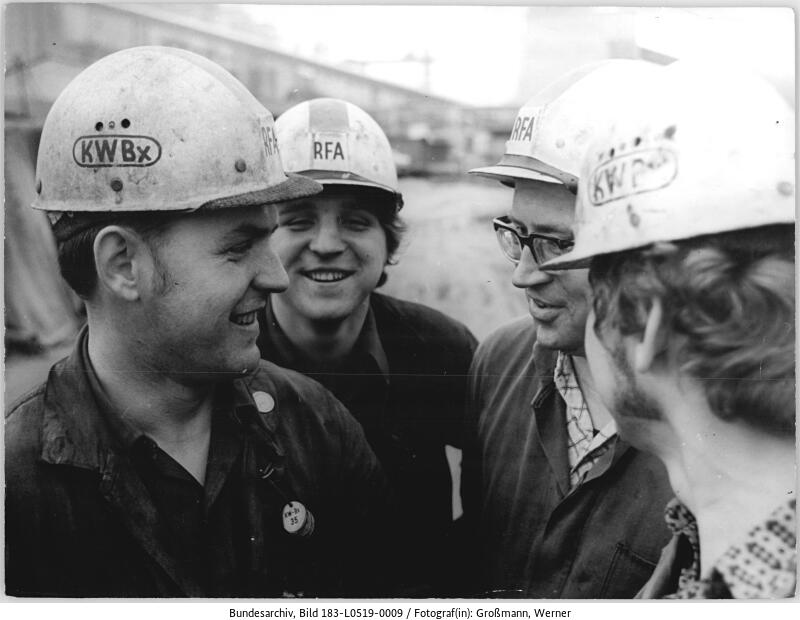
“I was born in 1948, at a time when neither the GDR nor the FRG existed. I attended school in my hometown of Zeitz. Zeitz is located at the intersection of the states of Saxony, Saxony-Anhalt and Thuringia. After the tenth grade, I completed an apprenticeship as an industrial locksmith at ‘BKW Erich Weinert’ in Deuben. Shortly after finishing my training, I completed 18 months of basic military service in the NVA. Afterwards, I began working as a welder on installation projects. It was during this time that I met my wife. Shortly after our wedding, we both started working at the Boxberg power plant. We chose Boxberg because, after two years of employment as a married couple, we were allocated a flat there.
So we moved to Weißwasser, where we found a lovely three-room apartment. We were given a small allotment garden and built a shed on it. We also rented a garage for the Trabant. In the meantime, we became parents to two sons.
Even back then, I was socially active, for example as a cultural representative in the trade union, in the volunteer fire department, in the Society for German-Soviet Friendship and in the Cultural Association. In our housing community, we organised weekend trips to the Zittau Mountains, Dresden and other places. Union-organised bus trips were also used extensively.
Culturally, Weißwasser had a lot to offer back then. There was the community centre (Kulturhaus), which hosted countless events. Many residents of Weißwasser would gather at the ‘Am Wasserturm’ restaurant, sharing a beer or two. People would simply meet and talk with one another. The town offered many leisure and sporting activities in a beautiful setting. Dynamo Weißwasser usually set the tone in the smallest ice hockey league in the world, which consisted of only two teams.
We lived happily and contentedly in the GDR. Nobody had to worry about their job. We lived peacefully together in a communal way and had a bright future ahead of us. This is my personal experience, and others may not see it in the same way.
Then came the so-called Wende! Everything was turned upside down overnight. We had to reinvent ourselves practically overnight. Here in the east, many functioning systems were destroyed by the Treuhand. That was the ‘second dismantling’. Meanwhile, for people in the ‘used’ [old] federal states, everything remained as it was. Yet we were condescendingly instructed on how to behave based on their experiences. Many people were unable to cope with the new system and moved to the ‘golden West’ in search of better pay.
I returned to installation work, taking on roles as a locksmith and a welder through various temporary employment agencies. These jobs predominantly took me to western Germany, as well as to the Netherlands, France and Austria.
As my retirement approached, I wondered how I could contribute to my hometown. During my 20 years of project work, I had become almost alienated from this city, as I usually only made the long journey home every two weeks. I had to reactivate my old circle of friends and find new ones.
I became involved in various citizens’ associations and initiatives, and I also supported the mayor at the time. I was a driving force in the ‘Friends of the Volkshaus’ interest group for a few years. However, the Volkshaus burnt down a couple of years ago. My wife accompanied me in these activities for many years. Consequently, we often appeared together and tried to achieve positive things for our town in our own way. For example, we have supported our new mayor from the very beginning of her term in office. This was partly because we wanted a fresh start in Weißwasser — the former mayor was too arrogant for us and many other citizens.
Here in Weißwasser, it is difficult for many to speak with a unified voice for our town and our region. Some people only consider their own interests and forget about partnerships. Yet there are many good ideas. In Weißwasser, however, the many men who say ‘one ought to do this’ have the upper hand. They are then dissatisfied with what has been done, grumbling and criticising instead of participating, as we have been trying to do for years. I tell myself, only those who get involved can try to effect change.”